
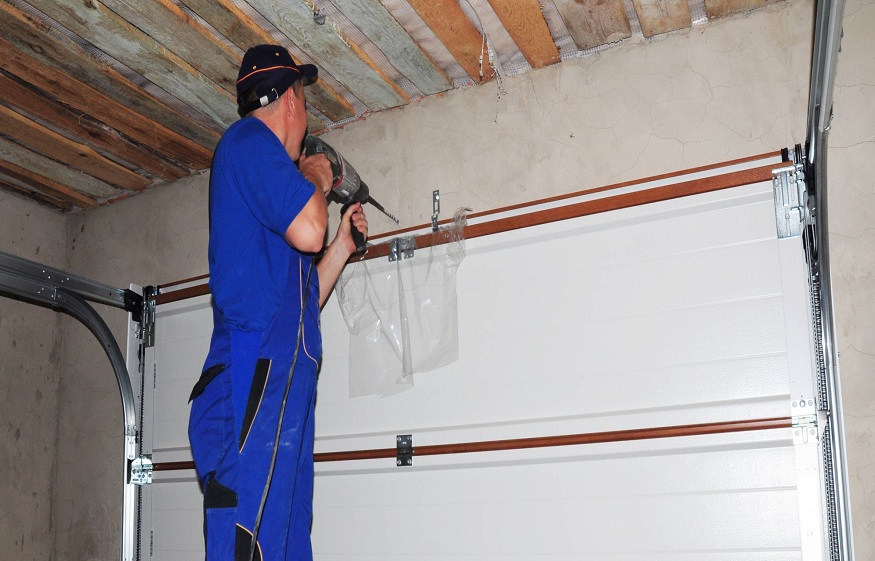
Garages are workhorses, housing your cars, bikes, tools, and other gear. They’re also part of your home’s first impression. To head off problems at the pass, give your garage a good once-over once a season, and pay attention to changes. You don’t need to bleed garage grease to do it. Just starting at one corner and examining your way around will do the trick.
When the Door is the Symptom, Not the Cause
In winter, a garage door that sticks but works fine in summer triggers a lot of misdiagnoses. Some of the time it really is a mechanical fault. But thermal expansion makes timber frames swell and tracks shift minutely. And if the track alignment is already borderline, the shifting from month to month is enough to set it over.
Track warping is stressing the entire door frame unevenly, and persistent binding will eventually distort the opening too. If making an adjustment to the tracks doesn’t stay the fix, the problem’s elsewhere in that structure and you’re going to want to get that professionally diagnosed and sorted.
Torsion springs and cables are the other places where the tell-tale signs get blamed on things they shouldn’t. A door that drops unevenly, moves jerkily, or just becomes impossibly heavy is a textbook spring failure. These parts work under enough mechanical tension to cause serious injury in untrained hands, and that includes using the wrong bar to adjust them. If you’re experiencing that mix of mechanical stress and broken structure, garage door repairs adelaide services are the call to make because forcing a failing system puts strain on the motor, the tracks, and the frame simultaneously.
The Difference Between a Harmless Crack and Warning Sign
Horizontal cracks must be repaired, but first, you’ll need to give the wall some relief by eliminating that pressure: Waterproof the exterior by regrading soil around the foundation, fixing or cleaning gutters, and ensuring downspouts extend at least 1.8m from the house. Add exterior drainage where needed.
Read More: How to Transition Your Child’s Bedroom from Toddler to Teen
Inside, indent the wall in 75mm intervals, drilling through the crack and every few inches along its length. This way polyurethane or epoxy injection can bond not just at the inner and outer surfaces, but between the bricks or cells of the block itself. A carbon-fiber reinforcement strap will also prevent future wall movement if mortared or bolted across the length of the crack.
Checking the Frame Before Checking the Door
The header beam is located right above the garage door opening. It transfers the roof structure’s load to the side columns. This is generally one of the components commonly forgotten in an old garage. When it sags, even a little bit, the door opening becomes distorted. The door sticks on one side, the panels separate unevenly, and the door system faces more strain than required. If the problem is ignored for some time, the header will also impact the roofline.
Equal attention should be granted to sill plates. These are the horizontal timber components located at the base of your walls and on the concrete slab. Since they’re in direct contact with the ground, termites and moisture will cause primary damage to these plates.
The pencil test is a practical field check: use a screwdriver or a pencil to push the wood hard. Healthy timber will resist the pressure. If you can easily slide it in the wood then the moisture has entered deep into the fibers and the plate needs replacement and not patching.
If you’re in the area, check if there’s a vapor barrier under the slab edge or along the wall base. Missing or degraded vapor barriers can cause rising damp and the continuous wicking up of the frame. Thus, the rot is inevitable regardless of how well you treat the surface.
What Poor Drainage Actually Does to a Garage Over Time
Blocked gutters, downpipes releasing water near the foundation, and ground that slants back toward the building are the three top drainage problems. They combine to direct water to the slab edge and lead to concrete spalling, rebar corrosion, and wall movement.
Read More: Creating Comfortable Outdoor Spaces on Any Budget
Concrete spalling begins as surface flaking but becomes progressive weakening when water enters the rebar holes and causes rusting. The rusting steel expands, breaking the surrounding concrete. Expansion joints in the floor are there to allow the concrete to expand and contract, if they are filled or sealed, the concrete will crack itself.
It is far cheaper to fix the drainage before the structure is damaged.
Protecting the Asset, Not Just the Building
Replacing a garage is one of those home upgrades that always earns a high return, with estimates ranging from 94% to 102% (National Association of Realtors). But only if the structure itself is in good shape in the first place. A new door facing that covers up a problem isn’t an upgrade at all.
You don’t need to become an architect to take this approach. If you just start by becoming a better observer of the odd creaks, cracks, and dips, they’ll start to tell you a lot more than you’d think.




Leave a Reply
You must be logged in to post a comment.